As much as I enjoy a good preamble in my blog posts, as those of you keeping score have no doubt noticed, there isn't a whole lot that can be said to precede today's entry. For those of you who may be new ( I think I might see one, way in the back there...), I had written this post about three weeks back, and in spite of the great feedback I received (seriously, all you guys are awesome), I felt there was something left unsaid. Truth be told, what I had really wanted for the first post right off the bat was more of a woman's perspective on the matter, though my efforts to receive such a perspective proved fruitless by my self-imposed deadline, and with no time to develop anything else so as to put my initial idea on the back-burner, I posted, and waited.
the backbone of this second part came to me via my Facebook inbox, in the form of young Jess Speedie. Some of you reading this may have met Jess before, but for those of you who haven't, allow me to offer some insight:
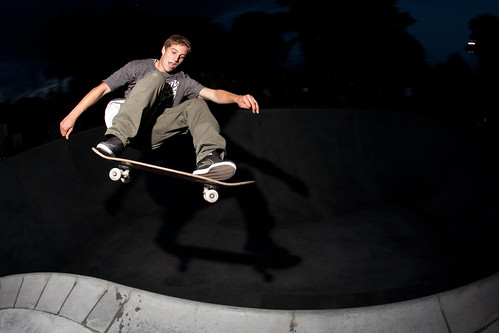
During 2009/2010, due to the fact that I had taken a year off from school, I took a second job as a skateboarding instructor at CJ Skatepark in Toronto. At the start of, I believe, the second week of Holiday camps in December, a young camper asked me if I was able to drop in on the park's twelve-foot tall vert ramp. I happily obliged the camper by proceeding to give all of the campers from that particular week an impromptu demonstration of all six tricks I can actually do on vert. Afterwards, I was approached by a young lady who had enrolled in the camp; she complimented my skating, and asked me if I would help her with her frontside airs. Eighteen months later, and she looks like this:
The young lady, for anyone not paying any attention whatsoever, is Jess Speedie.
When I took it upon myself to query Jess about the nature of women and femininity in skateboarding, she was, unbeknownst to me, spending a week at Woodward further honing her abilities. Still, though, when the questions did eventually get to her, she was more than happy to offer her insight.
BTJ: As a skater, how did/does being surrounded by males affect your personality/interests outside of skating, if at all?
Jess: Frontside Ollie
JS: Well, I have to say, being around males does affect my personality. It inspires me and pushes me to be more out-going, and less finicky about trying new things. And also to be willing to go all out, and be tough and strong all the time. Basically to just stand out, and be proud and aggressive, despite any differences, disadvantages or lack of experience that I may have. In terms of interests though, it doesn't really affect me.
BTJ: Do you feel the majority of female skaters are inherently masculine? Why or why not?
JS: No, I don't think female skaters are inherently masculine. I think they just enjoy flowing around on a skateboard (for me personally, I love the rhythm and freedom of skating, it's kinda like music). They're attracted to the same thing about skateboarding that males are. But that doesn't make them masculine.
BTJ: Is there a place for femininity in skating, or will it always be perceived as a hindrance?
Erin Wolfkiel, potential X-Games Medallist.
Way to blow it, ESPN
JS: I think there is a place for femininity in skating, I just don't think it's that big or popular. It will probably be a bit of a hindrance until a girl comes up who has dialed 720s and can skate strong and aggressively; someone who is as fun to watch as one of the pro male skaters.
For that last question:
While I was at Woodward, I met a female skater, Erin Wolfkiel (she was my counsellor). She was going to compete at the X Games until the women's division got so wonderfully cancelled. During my time with her, we had some really great conversations, and I discovered that she has some super interesting ideas to offer about female skateboarding, the challenges it will face, and its future. She thinks in a really cool way. I think you should get some opinions/answers from her, she really wants to get her message out there and heard, and she honestly has some amazing things to say. If you'd like, I can contact her and ask her your questions and send you her response. I think it would make your blog post even more interesting and thought-provoking.
I did take Jess up on her offer to gain some more insight from miss Wolfkiel, however at this time Erin has not, for whatever reason, been able to offer her two-cents on the matter. Said lack of communication notwithstanding, however, I do feel inclined to share with you a short documentary featuring Erin, that may, in fact, answer some of my questions inadvertently.
I want to end this post not by offering my own insight, as I feel I did so fairly thoroughly in the first part. Instead, I want to urge those reading this blog to ponder this matter on their own. Form your own opinions based on what you know and what you've seen. To the male readers, maybe use this an encouragement to get your sisters/moms/girlfriends/wives to give skateboarding a try, and to the female readers, use this as a fire to go out, grab a board, and learn how to rip, or rip harder. Who knows, one day you may be doing frontside airs higher than the person you got to teach you them in the first place.
When considering what to write about for the Monday's post, part of me wanted to assume that there were going to be hoards of skate bloggers out there who were no doubt going to recap this weekend's X-Games, and that perhaps ESPN's annual Hawk and pony show would, by the time this post goes live, be flogged to death worse than crailslides were in the mid 2000s. Then, of course, the thought occurred to me that "wait a minute, this is the X-Games... No one is going to blog about them because no one cares enough to watch them anymore!" To be fair, I stopped watching the X-Games on TV probably about five or six years ago. When I was younger, I remember being upset because TSN (Canada's equivalent to ESPN, for those of you not living here) would never show the street contests on TV. I mean, yes, vert was cool to watch, but at that point I didn't skate transitions, and street was my deal. Eventually, I got tired of being disappointed by one of the two or three Canadian simulcasts of the contest being motocross, BMX, or Rally Racing, and truth be
"Street" Obstacle, 2010.
told, even if I had the opportunity to watch skating, I found the vert and big air contests had become formulaic (whoever does the most rotations wins), and the street contests were predicable and boring, with horrendous layouts that looked like neither street nor skatepark, but rather some manner of oversized modern art gallery. Like most skaters, I scoffed at the redundancy of the contest, and if I really wanted to watch the footage, I knew it would be online in a matter of days.
Street obstacle, 2011.
Oddly enough, something broke me this year. Something within me compelled me to set me PVR to record whatever X-Games coverage was being simulcast up north, without having any knowledge of what said coverage would be, and proceed to watch it at my nearest possible convenience. Truth be told, I think a large part of it had to do with this year's frankly astonishing street course, though I believe a lot of it could be attributed to the fact that in the last few years, someone slapped ESPN good and hard. Perhaps it was on account of the whole cancelling vert debacle a few years back, though I can only really speculate. Point is, it seems as if the coordinators of the X-Games may have finally realized that, in spite of their admittedly impressive seventeen year tenure as an annual multi-discipline contest, and in spite of making for a good payday for the competitors, the contest had become the butt of ninety-eight percent of the jokes told by its bread and butter, skateboarders (the other two percent consisting of Jeremey Rogers jokes).
Of the four days and plethora of different events that made up this year's contest, for some reason TSN only allotted two hours of coverage on Friday and two on Sunday, meaning that of the four days and plethora of events, Canadian TV coverage was made up of two hours of skate street preliminaries, and two hours of rally racing finals. Needless to say I forwent the rally cars. The street prelims were held on the Friday, though in a house with six people and fewer TVs, the PVR proved to be a godsend.
Saturday morning I made a point to wake up early enough to watch the street prelims before the TV would be commandeered in the name of sports to which I hold no interest, only to have something very interesting happen. As I was in the midst of watching the end of the third of four heats, my dad walks into the room to take care of a few things for work. As I was preparing myself to turn over the remote control, I hear a comment from my dad about Ryan Decenzo:
"Hey, he looks kinda like you!"
"Yeah, I guess. Maybe it's because he's Canadian. He's in first right now."
"No kidding! Good for him!"
As the fourth and final heat carried out on TV, I found my dad making more and more comments about what he saw:
"Aw, man, that was cool." (In response to a number of David Gravette's more unconventional tricks).
"Huh. So he is human." (After seeing Nyjah Huston miss a trick).
Being the only person in my immediate family to ever have any real interest in skateboarding, it was strange to be sitting, having that kind of a moment with the same man who, as I was a young teenager, assured me that I would eventually stop skating. I talked about the whole experience with Deanna over the weekend, and it got me thinking; maybe there's a reason that, even though the X-Games have had a history of being maligned by skateboarders, they have managed to persevere for nearly two decades now. Maybe the secret to the X-Games' success lies in their ability to make the sports it covers relative to those who don't actually participate in them.
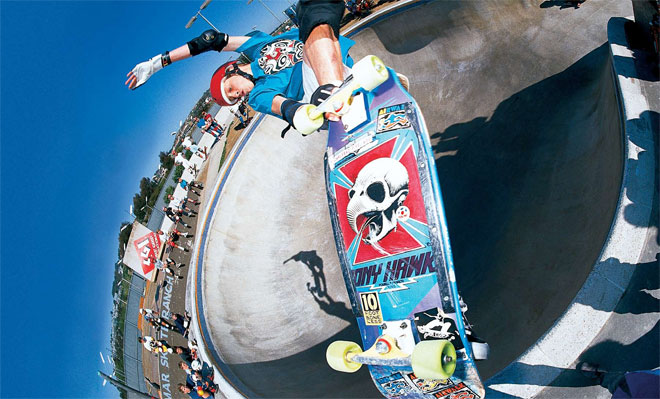
Tony Hawk RIDE tried, but couldn't hack it...
I can understand why most skaters would rally against such a thing, and I may take a modicum of flack for saying this, but I, for one, see no problem in being able to try and share skateboarding with non-skaters. If the coordinators of the X-Games have somehow figured out a way to make a televised skateboarding event that people who don't skate can watch, and relate to, than I, for one, am all for the idea of skaters being able to sit down in front of the TV for four days in July with their families, friends, and significant others, and have a moment in which the joys of the activity they love can, to a degree, be shared with the people around them. Provided the contest coordinators continue their recent trend of listening to actual skateboarders before making decisions (cancellation of women's vert notwithstanding), the future looks surprisingly bright, and I will set my PVR to record the contest next year, in the hopes that I will be treated to some more actual skateboarding, anyway.
There are seldom few things in this world that genuinely annoy me; I tend to follow a "live and let live" kind of mentality, and in doing so I make a habit of letting others' idiosyncrasies slide past me in the hopes that they will afford me the same immunity of my own. That being said, one of the aforementioned few things that do have a habit of getting under my skin is the use of the term "big words". Perhaps it's better that I elaborate on this point: while I have always had a well-rounded vocabulary and a generally good sense of eloquence, I don't want to come off as some kind of pretentious blowhard who scoffs at the lowly troglodytes who refer to words with roots more Latin than Germanic as "big". Rather my bone to pick is with those people who, whilst I am in the midst of trying to have a conversation with them, take their first opportunity to look at me, wide-eyed as a child witnessing it's first snowfall, and proclaim "wow, you use a lot of big words". I have heard that sentence all to often since I was young, and it bothered me as much in fourth grade (my first real recollection of such an event) as it does now. There is very little that I find quite as much a social turn-off as feeling like saying anything with three or more syllables will fly clear over any one individual's head; it makes trying to have a conversation with said person nigh impossible after that point, and forces me to instinctively judge them for sounding so infantile, leading to self-judgment of my own pompous windbaggery.
Chill, Dude, your kid's in good hands.
While my competent grasp of the English language may not have ever been particularly useful at parties, it has proved an invaluable tool in skateboarding, namely in all my years teaching it. While I have taken ineffable joy from watching as young skaters better themselves under my tutelage, I have had the opportunity to gain further satisfaction in allowing myself to be a face and a voice for skateboarding, especially to those who don't skate. Knowing full well the stigmas and stereotypes immediately associated with skateboarders, I have always made an effort to, when interacting with parents, show that while skateboarders may not all be the most well-kempt, individuals, we are not all the Spicoli-voiced mental midgets that the world has, by and large, made us out to be.
What I find infuriating, though, is that for all my efforts to shuck this veil of unintelligent slackerdom from myself and anyone else who skateboards, the stereotype somehow manages to perpetuate itself. It amazes me to even see that there are sponsored amateurs and young pros these days who do not have their high school diploma. Again, I try not to be a judgmental individual, and I am aware that many of the older pros had little other choice but to drop out in order to further their careers as skateboarders; between contests, demos, and eventually filming duties, their schedules quickly became non-conducive to spending seven hours a day for nine months in a classroom. Many of these pros have gone back and received their diplomas, and for this I commend them. The current generation, however, has no excuse. It has been made clear the options that these kids are afforded; home-schooling, correspondence courses, and even some schools allowing actual skateboarding to be treated as a Physical Education credit.
While Louie did his undergrad in English, he actually has his
Masters in fingerflip lein-to-tails.
Could one argue that there is simply a lack of educated role-models for these young skaters? Hardly. John Rattray, Adelmo Jr., Rob Gonzales, Louie Barletta, Andrew Cannon, and several other well-established pros are not only high school graduates, but university graduates as well. Rattray is well-versed in literature from Darwin to Vonnegut, Barletta had the initial dream of being a professor of English, and Cannon is, himself, an accredited high school teacher! I oftentimes get excited when I have the opportunity to read or watch an interview with more educated pros, because I am usually treated to some really intellectual stuff. So, having established that most of North America has tried to make high school nigh-impossible to fail, and knowing that there exists well-educated skateboarders all the way up to the professional ranks, one must ask why so many skateboarders allow themselves to be viewed as slack-jawed lowlifes.
Behold, the face of popular skateboarding......
The answer, I think, is due largely to the fact that, for as much as I can wax poetic about Rodney Mullen's 4.0 GPA studying nuclear physics, skateboarding has always seemed to make a point of celebrating stupidity. Now, on the one hand, I could ramble on for days about CKY, Jackass, or even Shake Junt; anyone who skates knows what I'm talking about, and many (especially in reference to Shake Junt) may take this as a kind of unwarranted attack from some know-it-all who uses big words to make up for the fact that he can't do switch flips.
See what happened there? This largely comes back to the "big words" point I made at the start of the post, and kind of the larger problem in general. Not just skateboarding, but society on a whole has, for years, celebrated inanity; I mean, for god's sake, I spent the entire last year in a University lecture on Classical History, sitting just in front of a young woman who one day proudly proclaimed to her two cohorts that in an effort to sound smarter, she was reading the dictionary to learn some, you guessed it, big words. The latest addition to her arsenal? Durgatory.
"Um, do you mean derogatory?" Cohort One offered.
"Oh, yeah, I guess so... I don't even know." She replied. Much giggling commenced.
Is this the guy who calls skaters "fags", or the guy gripping
your board at the shop? Is it sad that I can't tell?
So, what's the difference, then? Why would the average bystander shoot me a dirty look, and assume that I dropped out of school at fifteen, only to likely smile at Miss Durgatory? At the end of the day, what it seems to boil down to is that, as skaters, there are many of us who simply don't care how we are viewed by the rest of the world, to the point where it is almost an unwritten assumption that, as a skater, it is one's duty to shirk societal norms such as organized education, or education at all, for that matter, in favour of conforming to the decades-old paradigm of "coolness", with the unfortunate result being a celebration of acting like the kind of slack-jawed football jocks we all claim to despise, only without the promise of a scholarship to Notre Dame. The rest of the world, in turn, maintains the notion that skateboarders are just a bunch of good-for-nothing bums by virtue of the fact that most of them talk like they've hit their heads on the concrete one too many times.
So yes, contrary to what the above rant may cause one to assume, I am proud to be a skateboarder, and to be a part of so unique a subculture. That being said, though, I am also proud to be able to engage in intelligent conversations with the average non-skater, in the hopes that one day, such an act will not be seen as exceptional. Further, I implore the younger generations of skaters, those who perhaps fear ostracism in light of making known their capacity for complex thought, that there is no need to feel ashamed of or embarrassed by a well-nourished mind. Skateboarders have always shown a lack of fear in the face of big things, be they big drops, big handrails, big ramps, or big bowls; it's about time skateboarding got over it's crippling fear of big words.
I can't believe it's already been a month since I posted the first iteration of this segment. For that matter, I can't believe it's already been three months since I started this blog. To all of you out there who make up my regular readership, my sincerest thanks go out to you; you guys are the reason I put forth an effort to write original material and consistently post twice a week. That being said, I apologize for today's post being so late, hopefully my posting a regularly occurring segment named after a Spaghetti Western will make up for it. In all seriousness, though, thank you for the continued readership.
Thank-yous and dry wit aside, here are the BTJ Good, Bad, and Ugly for July 2011.
The Good: CPH Pro 2011
Some of you probably remember this post, in which I ranted from the metaphorical soapbox-atop-my-porch about these newfangled all-concrete plaza style street contests, and how they lack the kind of character of the good old wooden ramps, street and vert contests I had to skate ten miles barefoot through three feet of snow to watch. Well, on the one hand, I have watched the three stops of Street League up to this point this year, and have enjoyed doing so, as in all fairness the skating is of a very high level, and it is genuinely entertaining. That being said, I still stand by my arguments that 1) the all-plaza contest is not conducive to the current trend of all-terrain skaters, and 2) for the level of training and dedication required to skate transitions at a professional level, vert guys deserve more contests than they get.
Enter the 2011 Copenhagen Pro contest. I never, in previous years, paid much mind to skate contests overseas, save maybe the Bondi and Marseilles Bowl contests, but this year, by whatever strange pangs of curiosity (perhaps largely linked to doing "research" for the blog), I felt compelled to take a peek at the footage for this year's CPH Pro as it came trickling in though my various regular online skate news haunts.
Frontside Hip Ollie, CPH 2011 Bowl
The first thing that really drew my attention was Thrasher's edit of the bowl contest. It seems that bowl contests are really starting to overtake halfpipe contests, and maybe that's what ought to be happening; I mean, for one thing there are more skatepark bowls with vertical sections in North America now than thirteen foot tall vert ramps, bowl contests add a level of adaptability to the vertical contest circuit, as no two are alike, and although 99 times out of 100 a vert skater wins it, it is kind of cool to see the Runes, Pedros, Bobs and Buckys skating alongside the TNTs, Bingamans, and Taylors in the same contest. I think, though, past the actual skating in the contest, what caught my eye about the edit was the use of some fitting (read: 80s Hardcore) music. The individual who shared the video out on his Facebook page I think summed up many people's feelings about the music used in these internet skate videos pretty well with the comment "Minor Threat fits, not Michael Jackson..."
Frontside Hip Ollie, CPH 2011 Street
The next thing that really caught my eye was the layout of the street course, which really brings me back to the initial preamble of this section. Absent are the neck-high hubbas and fifty-foot long flatbars of Rob Dyrdek's Nyjah Huston show, instead replaced with a tight little L-shaped street course that's more Double Rock that Downtown LA. Apparently, the park designers got together and opted not to use California Skateparks' "let's make half the competitors soil themselves" model (possibly due to copyright restrictions), and instead thought that maybe a course that looked fun and enjoyable to skate wasn't a bad idea. And for those out there who still want to argue that this kind of layout isn't "real" street enough, take a look at the top three: 1)Luan de Oliviera, 2)Dennis Busenitz, 3)Chris Cole.
Your argument is in invalid.
The Bad: "Coolness"
Now, I know, historically speaking skateboarding has been far more elitist in the past than today: many pros have attested to the fact that these days you can get away with doing freestyle, or a footplant trick at a skatepark, whereas fifteen years ago such behaviour would result in sideways looks and hurled insults. So, why is it, then, that when Thrasher posts the now probably viral video of a kid doing an early grab backflip to 50-50 on a skatepark hip (yeah, you read that right) over half the comments on the video are negative?
Again, this:
Accompanied by such comments as:
...should have went in to fakie
gay
He's strapped to the board - that's why he back 3's so easily afterwards and stays stood on the board right to the end.
I like metal ramps and 3rd degree burns.
And my personal favourite,
Is this supposed to be cool?
Now, aside from the atrocious grammatical errors brought about by the ills of this generation, I really would love to know where these people get off, exactly, deciding what is and isn't "cool" in skateboarding. What's wrong, kids? Is it because the video doesn't feature Peter Hewitt or Burnside? Are you sad because you got made fun of for doing early grabs as a grom, and now you're transferring your own repressed feelings of inadequacy? Or maybe you just need to try to bully people on the internet to make yourself feel better because your two-mile-an-hour flatground hardflips don't look ugly, and now the big boys at your park won't count them in games of S-K-A-T-E. Whatever the modus behind it, we need to move past it once and for all, because if skateboarding shoots itself in the foot like this much more, how will it have anything left to push itself forward?
The Ugly: The X Life
Question: Have any of you out there reading this ever wondered what would happen if you crossed over one of those Real Housewives shows with the lives of three different action sports professionals? No? Me neither. Good thing no one ever brought that idea to fruition, right?
Oh, wait..... they did. And yes, it is awful.
Wait... Shouldn't you three be on TLC
or something...
You see, as per the aforementioned shooting oneself in one's own foot, there are a litany of stereotypes that anyone who actually cares about the health of skateboarding have been trying to shake for years now. The problem with shows like The X Life, as with most reality shows in general, is that the producers know very well that perpetuating the stereotypes inherent in the "cast" will lead to better ratings. As a result, once a week the same audiences, and their parents, who revel in such works of high art as Jersey Shore, Teen Moms,and Five Girls, One Gay, are treated to a half hour of a pro BMXer with a death wish and his ever-understanding, albeit clueless, girlfriend and kids, a pro motocross rider whose shrew of a trophy wife enables him to be an irresponsible man-child all the same, and an unassuming pro vert skater (Pierre-Luc Gagnon) who gives the impression that the only reason he's still with his psychotic loudmouth party-girl wife is because he secretly fears for his well-being otherwise.
Clearly an accurate representation of married life as a skater
Now, I'm not entirely sure where to begin here. For one thing, I want to point out that by no means do I know any of these people, and this initial impression of them is based on a heavily-edited twenty-odd minutes of footage that they are being paid to do. This, really, is the base of most of my gripes about the show. I am a huge fan of documentary, fly-on-the-wall type shows, such as the behind-the-scenes look at the offices of the webcomic Penny Arcade. Documentaries allow for the entire breadth of a person's or people's characters to show. In the case of shows like The X Life, along with every other reality skatesploitation pile of refuse that MTV has churned out in the past decade, the producers are not interested in realism, or documenting the entirety of their titular subjects, but are instead concerned with sensationalism. This, in turn, leads to a whole host of other issues. Skaters don't watch it because they know it's terrible, and oftentimes the skaters featured therein lose most, if not all their credibility within the fan-base. The people who watch the show, in turn, see little more that the perpetuation of the stereotypes that have haunted skaters and skateboarding since the '70s, and this, in and of itself, is not healthy for us. In short, these shows end up helping no one but the already-richer-than-you MTV executives, and I am left repeating my same plea from last month: Can somebody please get Stacy Peralta or Mark Jeremias on the phone and get some decent skateboarding back on the air?
Twenty-five years ago today, though I was unaware of it (and probably most things) at the time, a good portion of my life was set in stone. This twist of fate, one may even go so far as to call it destiny, came in the form of Brad McGinn making his way into this world.
When we were kids, Brad and I were often mistaken for
brothers; to this day, that hasn't changed.
I met Brad for the first time in Kindergarten; he was, if I remember correctly, a good couple notches more hyperactive than I was. Making friends at such an early age usually involves little social vetting, and the resulting friendships almost inevitably dissolve sometime between the next day and high school graduation. Brad and I, in spite of a brief falling out in the sixth grade, were almost inseparable through more or less all of grade school. By the end of eighth grade, however, the friendship had seemed to have run its course.
Brad and I spent the majority of our high school years with different friends, doing different things. I hung out with anime geeks, skated, and started listening to punk rock, and he hung out with goth kids, got into running, and started listening to metal. Come senior year we had but one common friend, and through said friend he and I reconnected.
Also, I found out that Brad had just started skateboarding.
I often like to recount the first time we skated together. I invited Brad out to my subdivision, to skate a modular park that set up in the parking lot of the local soccer fields. All told, not much skating happened, because about twenty minutes into the session, Brad's brand new ten gig iPod fell and broke*.
Even our trick selection seems related: twin streetplants, 2009.
To this day, I truly cannot think of what my skateboarding would have been like were it not for that day back in 2004, or for that matter, this very day back in 1986. Since then, Brad and I have learned tricks from and with one another, skated contests and demos together, released parts for the same videos, and even wound up skating for the same board sponsor. We've watched each other progress and mature, not only as skaters, but as people in general: I watched him learn inverts and frontside grinds, and at the same time I watched him meet the love of his life, and was one of the first people to see her engagement ring, even before she did. I visited him when he broke his leg, and he did the same for me. The stories I have are nearly unending, but for the sake of relative brevity I'll leave them at that. Though we now live far enough apart and have enough responsibilities that we don't skate together all the time, and very rarely for an entire day, when we do get together we have just as much fun as we did back in high school, learning bertlemanns on our local pyramid and then going to Taco Bell and ordering drive-thru with fake Scottish accents.
I may have learned frontside airs first, but Brad's got 'em
better than I probably ever will.
Brad has told me from time to time that he's not sure if he'd still be skating if we weren't such good friends. While I hate to entertain the notion for either of us, I wonder if I could say the same. Thankfully, I need not worry about the notion, as the litany of e-mails and text messages between the two of us contemplating trick ideas only serves as a confirmation of the fact that he and I are in this for life.
So happy birthday, Brad. You are, among other things, a great skater, a stand-up guy, and very possibly the best friend I could ask for. Enjoy your day, and I'll see you at the party this weekend.
*Editor's note: Don't worry about the iPod: Brad got the extended warranty, and got it replaced the next day.
As per usual, before I kick off the main attraction today, I have a brief announcement. I was thankful enough to receive many a good word about my previous post. My greatest worry in writing it was that, being written from a singularly male perspective, it would come off as skewed and one-dimensional. I had planned to gather some insight from some female skaters with whom I am pleased to be acquainted, but due to scheduling conflicts said insight was unattainable in time. The good news, however, is that I do plan on posting a second part to the story, focusing on what the ladies have to say. In the meantime, however, you're still stuck with just me and my usual semi-weekly ramblings.
On that note, on to your regularly scheduled ramblings!
I don't typically watch the annual Battle at the Berrics contest. If any of you reading this are under the age of eighteen, you are likely completely flabbergasted, but either those who know me or are past the age of suffrage are likely much less surprised. That being said, while spending three months following several professional bracketed games of S-K-A-T-E appeals little to me, I did recently watch the final match of the latest iteration, if only because Morgan Smith conquered PJ Ladd, and the fact that he did so on Canada Day tugged on my red and white heartstrings just tight enough to cause me to click "play".
Above: Morgan Smith. Ten points to those who know where this spot is.
The first ever indoor park I skated was the now-defunct Common Ground. I only ever skated there once, with Brad, who had skated it several times before and after. It was 2005, and I can remember Brad describing to me a park local named Morgan Smith, whose flatground flip capabilities were seemingly more on-point than the lines of flash code that Brad now uses to make a living for himself. The day I went to the park, sure enough, Morgan was there, and sure enough, his flip tricks were flawless. At the time, I thought it was astonishing. To this day, I maintain that. Somewhere, however, in the last six and a half years, something changed. The kind of cleanliness and perfection I once sought after, drooled over, and stood in amazement of, became astonishingly boring.
Above: "Illusion Flip"
I think, somewhere down the line, it started with hardflips. Yes, the bane of many a burgeoning street skater's existence. There was a time, for those of you who either weren't around or don't care to remember, when the hardflip could be executed in what has now been dubbed an "illusion flip" style: legs spread eagle, knees bent up toward the armpits, and the board kind of folding over itself while half-flipping. Technically, the kickflip frontside shove-it motion the board was supposed to be doing could be miniscule, at best, and somewhere down the line, someone decided that this would not do. By about 2003, no self-respecting magazine ran photos of hardflips unless they were flipped and rotated to perfection. Skateboarding had upped its standards of acceptability, and the "illusion flip" went the way of the benihanna and the stinkbug frontside air. This was how it was supposed to be, right? Progression is what keeps skateboarding moving, right? Well, yes, but here is where I and the rest of skateboarding seem to disagree: I think proper hardflips, by and large, look awful.
Above: a "proper" (read: hideous) hardflip
Now, to be fair, there are people who, on occasion, manage to add some flair to the modern hardflip and make it digestible. Truth be told, these people are probably why most overlook how the majority of skaters look doing it: legs and arms swiveling about wildly before attempting to achieve a kind of mid-flip fetal position, knees at one's chin, ankles nearly fusing together, hunching up like some kind of ungodly marriage of Sonic the Hedgehog and Gollum.
"But Brandon," you probably aren't saying, but I am for the sake of furthering this post, "who cares if most people make the hardflip look like the time-lapse of a shriveling prune? The board flips perfectly, and they always land perfectly on the bolts. Perfection is good, right?" Well yes... and no. Precision is important with modern flip tricks, and the hunchback flip is probably the most awkward flip trick conceivable, but at the end of the day, it is simply an unattractive looking trick for most. Just because you can play the solo to Master of Puppets flawlessly at an eighth the original tempo does not mean you should play it in front of an audience.
Above: This used to be considered "robotic" and "style-less"
So, why so many photos and video clips of Igor flips? It comes back to Morgan Smith and the Battle at the Berrics. As skateboarders, and skateboarding on a whole, have become more technical, style has been pushed aside in favour of perfection and cleanliness. Actually, allow me to amend that: Style has gradually become synonymous with perfection and cleanliness. Aesthetic appeal now no longer depends on how a skater looks doing a trick, so much as with how little effort he or she appears to have done it.
I maintain that the amount of skill necessary to perform any maneuver from any stance with perfect form is a very noteworthy feat, but to what degree are we allowing this obsession with sterile Orwellian skating to rob us of the soul of individual style?
Above: Nollie flip.... I think.... hard to tell... Oh well, BOLTS!
Nollie flips are a prime example of my point. Specifically, the flatground use-in-a-line variety. Paul Rodriguez could probably pop fifty in a row across an eight-inch wide ledge without breaking a sweat, and anyone who didn't know he was goofy wouldn't be able to tell if they were nollie or fakie. Good for him; I'm sure when skateboarding makes it into the Olympics, the hard-nosed Russian judge will give him a 10.0 on his dismount. Conversely, someone like Fritz Mead or Tony Trujillo would pop a nollie flip with such reckless abandon and so little actual nollie experience that they would likely have a hard time passing a sobriety test with it, even in a state of complete sobriety. The difference? The latter oozes the kind of personality that the former seems afraid to roll over for fear of getting it on its fresh white Nikes.
And I, for one, would take personality over perfection any day.
I apologize for missing Monday's update: this post was a bit of a doozie, and required a week's worth of attention. Hopefully you agree that the extra time spent was worth it.
So, my girlfriend skateboards. She didn't always, and as a matter of fact it was not until about a year and a half back, when she casually decided to play around with one of my spare setups, that the thought of riding a skateboard had occurred to her at all.
She loves skating, and she has a blast doing it, though despite her frankly uncanny sense of balance, she rarely skates, and never without me there. I really can't blame her; putting oneself out there on a skateboard, especially in front of other skaters, can be intimidating until you feel comfortable enough. I had the good fortune of picking up skateboarding at a relatively young age, and having a big unfinished basement in which to hone my skills before really ever skating at parks with any kind of frequency, whereas my girlfriend is twenty-three, and really has nowhere private where she can increase her comfort level and boost her confidence. Further, and as much as it pains me to say it, it doesn't help that my girlfriend is, you know, a girl.
Men are from Mars, Women are from Venice, amirite guys?
I touched very briefly on the issue of the role of women within skateboarding back in my video games post, but I think the issue goes far beyond the existence of Hubba Wheels ads. I can't really blame my girlfriend for not wanting to go to skateparks to skate; as it stands, skateparks are intimidating places for the average twelve-year-old boy who hasn't mustered the skill set required to ollie down some stairs or rock fakie a quarter pipe. At the very worst, this kid is shot the odd look of annoyance for getting in the way. Put a young adult woman in the same scenario, and the intimidation factor is amplified three-fold, and worries of being secretly judged as "just some dude's girlfriend getting in the way" can result in crippling self-consciousness.
Occasionally, my girlfriend and I will watch a skate video together. After doing last week's review of the Element video, we decided to watch it together because 1) She read the post and was interested, and 2) I thought she might get excited watching Vanessa Torres' part in the video.
I don't want to sound chauvinistic, but I always think that girls might get as, if not more excited watching a good part with a female skater than a good part with a male skater, that it might help boost a female skater's confidence by watching another female skater rip it up. If I'm wrong in this assumption, than it really only adds more fuel to the point of this post. My girlfriend has watched plenty of videos, and has seen plenty of female skaters, and while she appreciates the skating in general, there is often one point that she brings up when the female skaters take the screen:
"Why do they always dress like frumpy dudes?"
In writing about this, I am aware that I am walking on a dangerously slippery slope of thin ice. I had never really considered the implications of how female skaters dress until it had been brought up by another female skater. While I don't wish to generalize here, I think it is safe to say that the majority of female skaters dress rather masculine. If this is how they choose to dress, far be it from me to point fingers and dissuade; comfortable jeans a t-shirt and a trucker cap are what I like to wear when I skate, too. What worries me is not that some girls choose not to dress "girly", but that they may not feel like they have a choice in the matter.
Let's be honest: Elissa Steamer's Madonnas are better than mine.
As mentioned above, a skatepark can be an intimidating place for any skater, and more so for a girl. Skateboarding is an inherently rough and tumble activity, and the girls who skate may very well be nervous enough about being judged on their skating, much less about being seen as some frou-frou ditzy twit who doesn't want to ruin her new manicure. I can understand that oftentimes these girls are just trying to fit in and be "one of the guys", and anyone in any social atmosphere has experienced the same. The ironic part of it is that as of late I have seen more eyeliner and tight pants on male skaters than female ones.
Blogger's representation of half of all current skatepark patrons
I think the real solution here, if I may be so bold, is greater female participation. If the vilification of femininity in skateboarding stems from puerile adolescent stereotyping, than bring in some more girls to kill that stereotype dead. I, for one, welcome the notion.