I can't believe it's already been a month since I posted the first iteration of this segment. For that matter, I can't believe it's already been three months since I started this blog. To all of you out there who make up my regular readership, my sincerest thanks go out to you; you guys are the reason I put forth an effort to write original material and consistently post twice a week. That being said, I apologize for today's post being so late, hopefully my posting a regularly occurring segment named after a Spaghetti Western will make up for it. In all seriousness, though, thank you for the continued readership.
Thank-yous and dry wit aside, here are the BTJ Good, Bad, and Ugly for July 2011.
The Good: CPH Pro 2011
Some of you probably remember this post, in which I ranted from the metaphorical soapbox-atop-my-porch about these newfangled all-concrete plaza style street contests, and how they lack the kind of character of the good old wooden ramps, street and vert contests I had to skate ten miles barefoot through three feet of snow to watch. Well, on the one hand, I have watched the three stops of Street League up to this point this year, and have enjoyed doing so, as in all fairness the skating is of a very high level, and it is genuinely entertaining. That being said, I still stand by my arguments that 1) the all-plaza contest is not conducive to the current trend of all-terrain skaters, and 2) for the level of training and dedication required to skate transitions at a professional level, vert guys deserve more contests than they get.
Enter the 2011 Copenhagen Pro contest. I never, in previous years, paid much mind to skate contests overseas, save maybe the Bondi and Marseilles Bowl contests, but this year, by whatever strange pangs of curiosity (perhaps largely linked to doing "research" for the blog), I felt compelled to take a peek at the footage for this year's CPH Pro as it came trickling in though my various regular online skate news haunts.
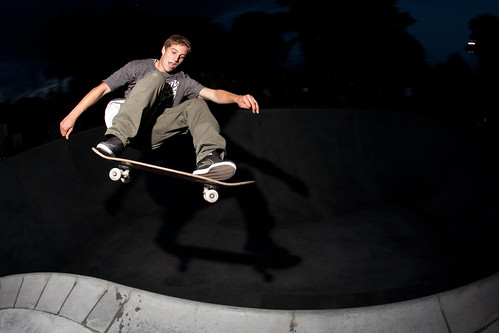
Frontside Hip Ollie, CPH 2011 Bowl
The first thing that really drew my attention was Thrasher's edit of the bowl contest. It seems that bowl contests are really starting to overtake halfpipe contests, and maybe that's what ought to be happening; I mean, for one thing there are more skatepark bowls with vertical sections in North America now than thirteen foot tall vert ramps, bowl contests add a level of adaptability to the vertical contest circuit, as no two are alike, and although 99 times out of 100 a vert skater wins it, it is kind of cool to see the Runes, Pedros, Bobs and Buckys skating alongside the TNTs, Bingamans, and Taylors in the same contest. I think, though, past the actual skating in the contest, what caught my eye about the edit was the use of some fitting (read: 80s Hardcore) music. The individual who shared the video out on his Facebook page I think summed up many people's feelings about the music used in these internet skate videos pretty well with the comment "Minor Threat fits, not Michael Jackson..."
Frontside Hip Ollie, CPH 2011 Street
The next thing that really caught my eye was the layout of the street course, which really brings me back to the initial preamble of this section. Absent are the neck-high hubbas and fifty-foot long flatbars of Rob Dyrdek's Nyjah Huston show, instead replaced with a tight little L-shaped street course that's more Double Rock that Downtown LA. Apparently, the park designers got together and opted not to use California Skateparks' "let's make half the competitors soil themselves" model (possibly due to copyright restrictions), and instead thought that maybe a course that looked fun and enjoyable to skate wasn't a bad idea. And for those out there who still want to argue that this kind of layout isn't "real" street enough, take a look at the top three: 1)Luan de Oliviera, 2)Dennis Busenitz, 3)Chris Cole.
Your argument is in invalid.
The Bad: "Coolness"
Now, I know, historically speaking skateboarding has been far more elitist in the past than today: many pros have attested to the fact that these days you can get away with doing freestyle, or a footplant trick at a skatepark, whereas fifteen years ago such behaviour would result in sideways looks and hurled insults. So, why is it, then, that when Thrasher posts the now probably viral video of a kid doing an early grab backflip to 50-50 on a skatepark hip (yeah, you read that right) over half the comments on the video are negative?
Again, this:
Accompanied by such comments as:
...should have went in to fakie
gay
He's strapped to the board - that's why he back 3's so easily afterwards and stays stood on the board right to the end.
I like metal ramps and 3rd degree burns.
And my personal favourite,
Is this supposed to be cool?
Now, aside from the atrocious grammatical errors brought about by the ills of this generation, I really would love to know where these people get off, exactly, deciding what is and isn't "cool" in skateboarding. What's wrong, kids? Is it because the video doesn't feature Peter Hewitt or Burnside? Are you sad because you got made fun of for doing early grabs as a grom, and now you're transferring your own repressed feelings of inadequacy? Or maybe you just need to try to bully people on the internet to make yourself feel better because your two-mile-an-hour flatground hardflips don't look ugly, and now the big boys at your park won't count them in games of S-K-A-T-E. Whatever the modus behind it, we need to move past it once and for all, because if skateboarding shoots itself in the foot like this much more, how will it have anything left to push itself forward?
The Ugly: The X Life
Question: Have any of you out there reading this ever wondered what would happen if you crossed over one of those Real Housewives shows with the lives of three different action sports professionals? No? Me neither. Good thing no one ever brought that idea to fruition, right?
Oh, wait..... they did. And yes, it is awful.
Wait... Shouldn't you three be on TLC
or something...
You see, as per the aforementioned shooting oneself in one's own foot, there are a litany of stereotypes that anyone who actually cares about the health of skateboarding have been trying to shake for years now. The problem with shows like The X Life, as with most reality shows in general, is that the producers know very well that perpetuating the stereotypes inherent in the "cast" will lead to better ratings. As a result, once a week the same audiences, and their parents, who revel in such works of high art as Jersey Shore, Teen Moms,and Five Girls, One Gay, are treated to a half hour of a pro BMXer with a death wish and his ever-understanding, albeit clueless, girlfriend and kids, a pro motocross rider whose shrew of a trophy wife enables him to be an irresponsible man-child all the same, and an unassuming pro vert skater (Pierre-Luc Gagnon) who gives the impression that the only reason he's still with his psychotic loudmouth party-girl wife is because he secretly fears for his well-being otherwise.
Clearly an accurate representation of married life as a skater
Now, I'm not entirely sure where to begin here. For one thing, I want to point out that by no means do I know any of these people, and this initial impression of them is based on a heavily-edited twenty-odd minutes of footage that they are being paid to do. This, really, is the base of most of my gripes about the show. I am a huge fan of documentary, fly-on-the-wall type shows, such as the behind-the-scenes look at the offices of the webcomic Penny Arcade. Documentaries allow for the entire breadth of a person's or people's characters to show. In the case of shows like The X Life, along with every other reality skatesploitation pile of refuse that MTV has churned out in the past decade, the producers are not interested in realism, or documenting the entirety of their titular subjects, but are instead concerned with sensationalism. This, in turn, leads to a whole host of other issues. Skaters don't watch it because they know it's terrible, and oftentimes the skaters featured therein lose most, if not all their credibility within the fan-base. The people who watch the show, in turn, see little more that the perpetuation of the stereotypes that have haunted skaters and skateboarding since the '70s, and this, in and of itself, is not healthy for us. In short, these shows end up helping no one but the already-richer-than-you MTV executives, and I am left repeating my same plea from last month: Can somebody please get Stacy Peralta or Mark Jeremias on the phone and get some decent skateboarding back on the air?
Apologies for the late post: life is like a hurricane here in Duckberg, you know how it gets sometimes...
Yes, blatant excuse to use this clip, can you blame me?
Ten points for anyone who can name the correlation between my opening sentence and the above video clip. Now then, on to the rest of the post.
Skateboarding Is.... Dropping In.
Riding down a transition. Really, Brandon? This is your big monthly revelation? Stop the presses and get Phelper on the phone, because somebody ought to pay this guy some good money for so poignant an observation!
Now, before you say anything, or maybe try to have me institutionalized on account of how much I talk to myself in this blog, hear me out.
Yes, I'm writing an entire post on the act of riding down a transition, because it is a maneuver that implicitly carries with it so much. As much as I disagree with the subversively militaristic nature of the Boy Scouts, I feel inclined to liken dropping in to that merit badge that every real scout eventually gets; not one of those easy ones like the one you get for keeping your brother's old hand-me-down comic collection, but one that requires a deep enough skill set that, by receiving it, you can verify and legitimize your connection to an elite group. It's a rite of passage, so to speak.
*Gulp* Wasn't this thing only four feet tall?
Perhaps part of what makes the drop-in so special is the process of learning it. Everyone remembers what it was like learning how to drop in: you know how to push around, maybe you've got tic-tacs on lock. Bank ramps are a joke to you now, you just roll right down them like nothing matters. You figure "a quarterpipe? how hard can it be?", and then you actually stand in position.
If there is one thing I have learned, or maybe re-learned, from years upon years of teaching kids how to drop in, it's that the inevitable battle that accompanies it is over fifty percent mental. Fear is, more often than not, one's own greatest adversary in skateboarding, and dropping in is the first real confirmation of that fact for most skaters. Learning how to drop in sort of contrasts with how most of us are instinctively wired to deal with fear: most anything in life that requires us to conquer our fears can usually be tiptoed into, so to speak. That is to say, there is often an acceptable middle ground with most things. When one is discussing the drop-in, however, this middle ground will get you hurt. The result? Endless numbers of skaters learning to drop in who, by virtue of their innate sense of hesitation, end up suffering the inevitable slam. Indeed, almost more so than anything else, a proper drop-in requires complete commitment and a mastery over one's fear. Those who have dropped in on anything can attest to the fact that rolling away successful for the first time is euphoric, easily on par with landing your first kickflip, except for the fact that one cannot really drop in on a ten square foot patch of their parents' basement.
I wonder if Tony reacted the same way to his first drop-in...
The most interesting thing, I have noticed, about dropping in, is that no matter how comfortable one gets at it, as soon as one is faced with doing so on a larger ramp, it is as if that feeling of comfort and fearlessness is magically erased. Speaking from experience, I can attest to the fact that there is very little difference between dropping in on a six foot mini ramp and a twelve foot vert ramp, and yet the amount of coaxing required to get me to drop in on vert the first time was astounding. Interesting, too, is the fact that the euphoric rush that accompanied my first successful drop in was present as well. All that was missing from the equation was the uncomfortable week of repeated slamming, replete with my stray board taking out a couple of spindles of the railing at the other end of the ramp...
In summation, dropping in is, at its core, just riding down a transition. Further analysis, however, shows a plethora of things. Dropping in is a personal landmark, a rite of passage, a conquest of one's own fear and an advancement of one's own abilities. Dropping in is skateboarding, and conversely....