Showing posts with label pro skater. Show all posts

Wednesday, 12 October 2011

A Public Service Announcement With Guitars: The BTJ Jason Adams Interview

I have no shame in admitting that I am a fan of Jason Adams.

The Kid has a timelessness about him, and about the way he skates. You see his photos, watch his parts, and want to go skate, pure and simple. He is, in many ways, a bit of a blue-collar hero.

I sent Jason an e-mail via his blog, on a whim, stating who I was, and how cool I thought it might be to ask a few questions for the blog. Now, I am a realist, and I understand that many pros live hectic lives with insanely bloated inboxes. It is for this reason that, when Jason was so quick to initially respond, much less agree to an interview, I was equal parts shocked at the speed of his response, excited by the prospect of getting a shot at interviewing one of my all-time favourite skaters, and flattered that he actually agreed to it.

What truly blew me away, however, was that, in spite of the fact that the actual interview took about a month and a half to do, that every week or so I was getting an e-mail letting me know that the interview was still a go, and that I had not been forgotten. Even if I were never a fan of Jason Adams beforehand, his willingness to take the time to keep up a correspondence with me over the last eight weeks or so, with really not much to gain from it, was enough to cement his place as an icon in my mind.

And so, without further ado, the Between Two Junkyards Jason Adams Interview.

1. So, first off, I want to touch on 1031. Hearing that you were going to be riding for Svitak got me really stoked, because as far as I'm concerned you guys made up part of what I consider to be the golden age of Black Label. How has it been skating alongside Kristian again after so many years? Being that you're kind of one of the veterans on the team, do you ever find yourself offering up any kind of mentoring or advice to the younger guys?
 
- I've never even met anyone on the team besides Kristian. I met Ben [Raybourn] one time...but ahh... then he quit. I don't get out of town much.....veteran for sure! Ha ha, I'm a somewhat stay at home dad these days. The days of touring and travel and free days skating, or  filming/shooting are pretty much a memory. A skateboarders life style doesn't fit in any where. I try!!! Damn it, I try!! It suits me to be a fancy free spirit......just ain't goin' down these days. 

2. You've released a staggering number of video parts over the years, and in watching all of them I've found that they have this kind of balance to them: not only do you manage to incorporate equal parts street and transitions, but also equal parts tricks that will amaze the average skater, and tricks that the average skater will want to go and learn right after watching. How important is it for you to maintain that sense of accessibility, to throw a slappy and slide line into a part with a lot of unique skating that most young street pros couldn't hold a candle to, much less your average grom?
 
- Well the way you broke that down is somewhat the way I would go into filming a part. Basically I go and film what's fun and comes natural to me. That said I also always wanted to make a statement about what I was into or what I thought was cool........ basically I never let go of my younger roots and influences in skateboarding. I always wanted to bring that into whatever I did in skating. But on the flip side... I knew I needed to come up with a few bangers and a few other moves to make it modern and relevant.


3. Speaking of unique skating, what's the trick behind your ability to seemingly wallride anything with a 70-plus degree angle?

- I have always been drawn to wall rides. Seeing the first crail snatcher or wallie in the mags was so awesome to me! Then when tech skating came in it was almost taboo to hit a wallride? That made me want to hit them more! the Gonz always did rad wall stuff. I really dug Tim Jackson back in the day too. That might have something to do with it. I guess I would find inspiration in choosing the road less traveled......these days there's just a lot of traffic.......

4. not to try and make you feel too old, but you've been skating long enough to have been privy to an insane amount of progression. What trick do you most vividly remember seeing for the first time? For that matter, what trick do you most vividly remember learning?

Hmmmm, good question. Hearing about Tom Knox doing a kick flip wall ride.....I would say around 86-87 man that was heavy.  JJ Rogers doing the first feeble grind on a hand rail in a blockhead ad. Hearing about Henry Sanchez doing a big spin over the seven at Embarcadero...........Danny Sargent back side slappy on the big ledge Embarcadero...... For me?...Ollie up a curb, kick flips......Front 360s off jump ramps. Rock and rolls on half pipes.......First board slide on a hand rail. Four stairs fool!!


5. I remember reading an interview you did in The Skateboard Mag where you talked about living a sort of nine-to-five lifestyle that lets you spend time with your wife and daughters. How difficult is it to be a full-time pro skater and a full-time grown-up? How do you manage that balance?

- I don't...... I don't consider my self a full time pro skater any more.... not that I don't want to be out doing it, or that I'm not skating. It's just that reality, economics and age set in. It had to happen some time I suppose...... but it was tuff for all those years of being a married father and trying to keep a skater's schedule going. It's like oil and vinegar! Even when the wife didn't have to work!


6. Anyone whose seen your art, read your blog, or watched any of your video parts knows how big an influence music is on you (I personally got into the Mescaleros thanks to your part in the enjoi video), and yet in terms of creative outlets other than skating, you gravitated toward the visual, rather than the audible. Why so? Have you ever tried your hand at music?

- Yes, and I'm not musical!! Anything I've ever gotten into it just became an obsession. I tried to get into playing music and it just didn't click?? I'm either lazy or lost or obsessed!!


7. I've noticed a trend in recent years that a lot of pros are no longer ashamed to ride their own models. I never really got the reluctance in the first place, because to me a pro model should be
something you as a pro should want to ride. As someone who has often ridden your own board, What's your take on the whole issue?

- The early 90's pro skate scene was retarded...for lack of a better word. It trickeld from that. But at the same time it could have been a backlash of the antics of some cheesy-ass ego driven pros of the 80s?? But really the 1990s were strange! Real strange!


8. On the subject, I know you like to switch up your setup frequently, but if you had to ride one size and shape the rest of your life, what would it be?

- I don't like that scenario...

9. You're stranded on a desert island with one album, one book, and one thing to skate. What are your picks?

- Man you are killing me.....The Clash, Sandanista; Stienbeck, Travels with Charlie; red curb.


10. So what is coming down the pipe for you in the coming months? What can all the Kid fans out there look forward to?

- Trying to stay focused, that's a tuff one for me. I want to do a few projects for my 20 years of pro skateboarding coming in 2012. Honestly I'm just trying to find my place right now, I'm learning how to juggle it all and stay consistant!!

11. Final question: Every so often on the blog, I'll write about some aspect of skateboarding that really personifies it. So if you'd be so kind as to finish the sentence; Skateboarding is...

- freedom....or at least a the closest thing to it.


I want to extend my hugest thanks to Jason Adams for taking the time for this.

Monday, 13 June 2011

Authentic Simulation, or the Art of Couch Skating

As like many skaters, my interests reach further than simply the act of riding a skateboard. Some make art, some make music, some even ride motocross. I, myself, am a gamer.
Video game culture, and being a gamer, has a lot of parallels, I find, with skate culture. Both acts have been historically scoffed away as being child's play; something cast aside as soon as one gets a driver's license and a girlfriend. On that note, both have historically attracted the socially maladjusted: many a skater who went to high school in the 80s or early 90s will recount tales of how admitting you skated was a sure-fire way to detract attention from the opposite sex - a trait undoubtedly shared by the gamers of the same era. Both have an admittedly shameful history of male-dominated participation, bordering at times on misogyny.
Both have seen an increase in acceptance and casual participation in the last decade, and both have a collective of 'core curmudgeons who often rue that this is the case. So why am I talking about all of this? Well, because today I'm talking about what happens when these two things come together.

Maybe six months or so prior to starting Between Two Junkyards, I had mused about the idea of doing a video-review show all about skateboarding video games, of which there have been countless iterations, dating back as far as the 1986 classic 720 Degrees Arcade game, ported to the Atari 2600. While I could go on for months on end writing reviews of the rarely good, often bad, and occasionally ugly history of skateboarding video games, it ultimately boils down to the fact that, for the last quarter century, video game developers have been trying to emulate the act of skateboarding, without actually using a skateboard.
  
Yeah... This seems about right...
What really got my mind stirring on this topic was a recent binge I went on this weekend of video game webcomics. Due to my inherent need to be completely up-to-date on whatever webcomics I read, I came across this strip about Tony Hawk Ride. It brought up an interesting point: it a skateboarding game good because it's fun, or because it's realistic?

Well... kind of both.

In preparation for this blog, I talked to my girlfriend, who both skates and is an avid gamer, her thoughts on the matter:

"[Realism]...because [a more realistic game] helps you learn tricks: if it's easy and you can't fail what's the point? No video game should be like that. Where is the challenge?"

Now, I will defend the first handful of Tony Hawk games to the death - they were great games, and they did the best job possible at the time of capturing the act of skateboarding. Unfortunately, however, as the games progressed, they jumped the shark in an unforgivably huge way...
I heard Brian Herman just Franklin Grinded the Hollywood 16.
RIDE was meant, I suppose, to remedy this, as well as jump all over the Great Peripheral Bandwagon of the late 2000s. The aforementioned comic argued that the game was too real to be fun, though as a skater who actually tried it, it seemed more so that the game was simply trying too hard, and fell flat both in realism and fun. A valiant effort, Tony, but you and I both know that skateboarding is far more complex than the game's controls can account for.

Perhaps EA's Skate series is the closest modern technology has come to offering a fun, challenging, and accurate representation of skateboarding. I know I've spent countless hours playing the games, whose admittedly intuitive control scheme did offer me some assistance on my real-life fakie bigflips. Still, though, at the end of the day, no ammount of thumb-based training can compare to the feeling of actually getting out there and feeling the board under your feet.

Although it is a nice way to kill time on a rainy day.

Thursday, 2 June 2011

My Thoughts on Others' Thoughts: A Review of "Stalefish"

Skateboarding, and skateboarders, owe an obscene debt of gratitude to Stacy Peralta. In his years as a professional skater, he may not have given us the frontside or backside airs, as did his peers Tony Alva and Tom Inoyue. At best, as a pro Peralta gave skateboarding backside 540 bertlemanns, frontside lipslides, and the knowledge that skateboarders, and skateboarding, could be marketed to the masses. As Peralta himself put it, it was behind the scenes where he truly flourished.
Perhaps it was the tutelage of Craig Stecyk, arguably one of the first skaters to become well-known and to make a career out of documenting skateboarding. Maybe it was Peralta's own ability to segue from having a career by skateboarding into having a career because of skateboarding. Maybe it's entirely ineffable. in the end, though, one cannot deny that Stacy Peralta has a unique ability to see where talent lies in a person, and to know how to guide said person toward cultivating that talent, honing it to the point of greatness.
The book Stalefish: Skateboard Culture from the Rejects Who Made it, was not written by Stacy Peralta, but rather, was penned by Sean Mortimer. One may be inclined to ask me why I just spent two paragraphs waxing poetic about Peralta as a means to preempt my review of a book that he did not author, which is valid. Mortimer, the author of Stalefish, as well as co-author of Tony Hawk and Rodney Mullen's autobiographies, rode for Powell Peralta as an amateur in the late '80s. As Mortimer once recounted in an interview, Peralta once overheard his musings as he shared an observation of a particular event. Peralta suggested Mortimer try his hand at writing, and for anyone who has read any of his works, this was yet another shining example of Peralta's innate eye for talent.
Stalefish the book is a few years old now, but is still, in my opinion, entirely worth reviewing, as I feel it to be somewhat underrated when cast in the gargantuan shadows of Occupation: Skateboarder and The Mutt. My girlfriend got me the book as a Christmas gift last year, and I am casually re-reading it now for what I swear is the tenth time.
The book is, more or less, a collection of anecdotes. The cast of contributing skaters is an astounding one that runs the gamut of skateboarding's past and present, as far back as Jim Fitzgerald and as contemporary as Chris Haslam, with a litany of others in-between: Russ Howell, Stacy Peralta, Steve Olson, Dave Hackett, Salba, Lance Mountain, Tony Hawk, Rodney Mullen, Tommy Guerrero, Kevin Harris, Mike Vallely, Bob Burnquist, Jamie Thomas, and Daewon Song round out the rest of the cast of characters, ensuring that no era or discipline is left unturned or unappreciated.
The stories themselves are not exactly autobiographical per se, as each chapter of the book focuses on a different aspect of skateboarding, and whomever has a tale or two to contribute as a means to chime in on the topic does so. In spite of the inherent looseness of the book's format, there is, understandably, some repetition in material for those who have read the Hawk and Mullen autobiographies. This is, of course, not necessarily a downside, which leads me to my next point.
What makes this book truly great, aside from instantly appealing to any and all skate-history nerds like myself, is that it is a collection of great stories being told by many of skateboarding's great storytellers. Anyone who has ever listened to Steve Olson say so much as three words will tell you that it is impossible to read anything he has written without hearing it in his voice, and that is not a bad thing. Most, if not all of the skaters interviewed for this book are so unique in their capacity to tell stories that one cannot help but hear their voices, be it Olson's cavalier slur, Mullen's excited mumble, or Mike V's intensity, every word truly jumps from the page, reverberating in the reader's head like the opening track of a favourite record.
While I cannot say enough great things about this book, no amount of my rambling will do it near as much justice as going out and giving it a read, and maybe later, nine more for good measure.

Stalefish is available for purchase here.

Sunday, 29 May 2011

The Colour Yellow, or Nice Guys Finish on the Podium

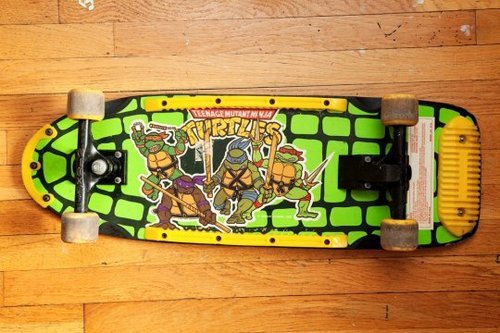
Ever since I was young, I was aware of skateboards, and of the act of skateboarding. In the late '80s and early '90s, I had a pig board-shaped Teenage Mutant Ninja Turtles skateboard, replete with copers, lappers, rails, and nose and tail bones.
 I can't believe I found an image of this first try - I put this exact board through the wall of my old basement....

Any knowledge I had of skateboarding came from that board, the Ninja Turtles, and an old copy of Skate or Die; Tour de Thrash my older brother had for his Gameboy. I didn't even know what tricks existed until 1992, when that same brother exclaimed to me that skateboarding was back (we had assumed in our youthful innocence that it was a fad of the 80s), that now boards had two kicktails, and there were new tricks like the ollie, and the kickflip. Aside from this newly acquired knowledge, however, I was still more or less clueless.

It wasn't until around 1996 or so that I discovered that there was such a thing as a professional skateboarder. I can remember simply stumbling onto a televised vert contest. I had no idea what any of the maeuvers being performed were called, or for that matter who most of the pros riding were...this was about two years before I started trying to pay attention to skateboarding, and four years before I actually started skating. The one part of the contest I most vividly recall, though, was a slow-motion replay of a skater doing a trick that, in hearing the commentator exclaim the names of both, my ten-year-old mind assumed was said skater's signature move, though I would come to learn otherwise. The trick was a McTwist, and the skater was Andy MacDonald.

It would be inherently difficult to argue that Andy Mac is well-liked among the majority of skateboarding's most key demographic, that is to say, teenage boys. In a subculture that celebrates aggression, rebellion, and oftentimes being at-odds with authority, Andy stands as a paragon of virtue, the kind of white knight archetype with a winning smile that you'd expect to see on a box of Wheaties holding a baseball bat, the kind of person that nine-and-a-half out of ten kids on the SLAP message boards wouldn't think twice about unloading a carton of eggs onto. He does anti-drug PSAs, is sponsored by a licorice company, and is pictured on the cover of his 2003 autobiography Dropping In with Andy Mac doing a benihanna. In short, Andy MacDonald is a dork, the type of guy who probably got called a poseur by the more "hardcore" skaters at school growing up.
Few things would have helped a skater's popularity in 2003 like doing the most hated-on trick on vert in full pads and a canary-yellow t-shirt.


When push comes to shove, however, one can see that, not only has the skate world been a bit harder on Andy than he ever deserved, but that skateboarding needs pros like Andy around. For one thing, he is an undeniably talented skater; many may argue that Andy's skating is jockish, or devoid of style, and to that I offer this rebuttal:

Secondly, yes he is a dork. He was probably as close to a model son to his mother as he could be, and is likely one of those dads that makes lame jokes that cause his son to roll his eyes incredulously. What this does not make him, however, is any less of a skater. One of the beautiful things about skateboarding is that it is meant to attract anybody who feels that they don't fit in elsewhere, not just thirteen to eighteen year old boys whose judgmental gazes and words make them bigger jocks than their schools' football teams. I, for one, can vouch for the fact that I tried to be a model son growing up, and I'll probably be a dad that tells lame jokes to his kids, and I'll always skate, which is more than I can say for all the "hardcore" skaters at my old high school that always called me a poseur. Finally, I can vouch for the fact that I'm glad that there are pros like Andy MacDonald, helping all those dorky kids out there feel a bit more at home.

Thursday, 26 May 2011

"It's a Living" or "How I Learned to Stop Worrying and Love a Paycheque"

Hi, my name's Brandon, and at times, I'm a professional skateboarder.

I'm sorry? Oh, no, I don't have a pro model board..... Yes, I am sponsored by a skate company...... Well, no... you probably haven't heard of them....

But, seriously, sometimes I am a professional skater. Not in my mind, not in video games, but for real.

Around the time of the Copenhagen pro contest, there was a video interview of Arto Saari posted up on the Transworld site, in which he tried to define that ever-so-delicate term in our business: "pro"


Arto Saari CPH PRO trailer # 5 from simon weyhe on Vimeo.

I can, to a degree, understand Arto's sympathies on the matter: the men and women who have pro models out with well-know board companies are some of the most gifted skaters the world over. Were it not for those few screens of ink forming a name on an internationally sold skateboard, there would be no delineation between Daewon Song or Chris Cole, and that local park hero who probably beats kids in SKATE for their lunch money so he can buy new boards. That would be like comparing Sir Ben Kingsley to that guy busing tables in Hollywood, hoping to land an infomercial gig, right?
Okay, so maybe I only name-dropped Ben Kingsley as an excuse to link this video...

And yet, say that actor lands that infomercial gig, and commercials end up becoming his livelihood, he's a professional actor, right? The poor guy may not be the next Ben Kingsley, but he is being paid to act. He doesn't need a production company to tell him so, and he isn't internationally known, but he is being paid to act.

Okay, so the acting world may be a little different than skateboarding, which can be considered an art as much as a sport. In terms of professional sports, then, what makes a professional golfer professional? There are literally hundreds of  professional golfers the world over, who are simply good enough at golf to be paid for it, be it from sponsors, competitions, or courses where the pro might give lessons or seminars. He or she may not have a Nike driver with their name scrawled across it, but they are paid to golf, or teach golf, and are ergo professionals.

In the premier episode of Mike Vallely's Drive series, Mike talked with Lance Mountain, in which Lance said, succinctly, and with his typical humble wisdom, that a pro skater's job was to "make kids fall in love with skateboarding". To me, this has no bearing on whether someone has a top-selling board the world over, but someone who is paid to make kids fall in love with skateboarding, whether it be through giving lessons, doing demos, filming video parts, or getting in Thrasher or Transworld every month.

That's why I can say, comfortably, that I am, sometimes, a professional skateboarder.